
I am so honored to be able to provide a home for this short film. Mayeni reached out to me over instagram a few weeks ago to see if I’d be interested in posting her 18 minute narrative short, Babyface, about the nuances of sexual assault. She told me how much this web project helped her through the whole process. In her own words, “Kill Your Rapist helped me through the entire process from my decision to make a film about it.”
I can’t begin to express how impactful every individual submission to the website has been for me personally. Oftentimes, especially when there’s a lull in submissions, I wonder if anyone is engaging with these works or if I’m just screaming into the void. The fact that Mayeni’s experience with the website has been so instrumental in her process brings tears to my eyes. I hope every person who has ever clicked on the link to this page or submits work knows how profoundly your efforts impact other survivors. It’s truly so special, not only to me, but to hundreds of people. Having a film, one that I find so relatable, one that illustrates so perfectly how we question ourselves, is a huge step for this whole world that’s been created. Thank you Mayeni, from the bottom of my heart.
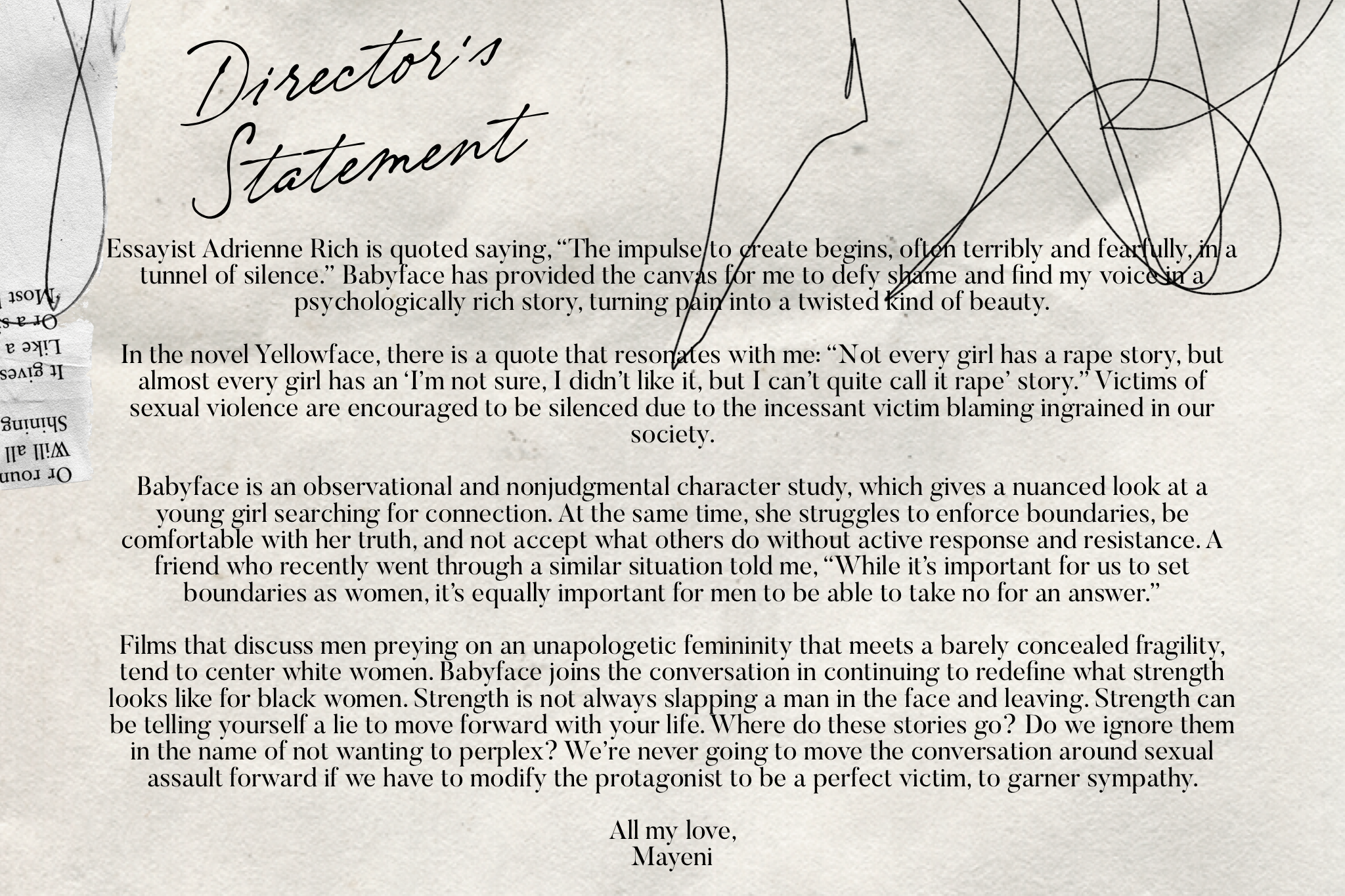
Below I will include a director’s statement from Mayeni, the link to the movie, which she has so graciously posted on Youtube for anyone to watch, and an interview.
***
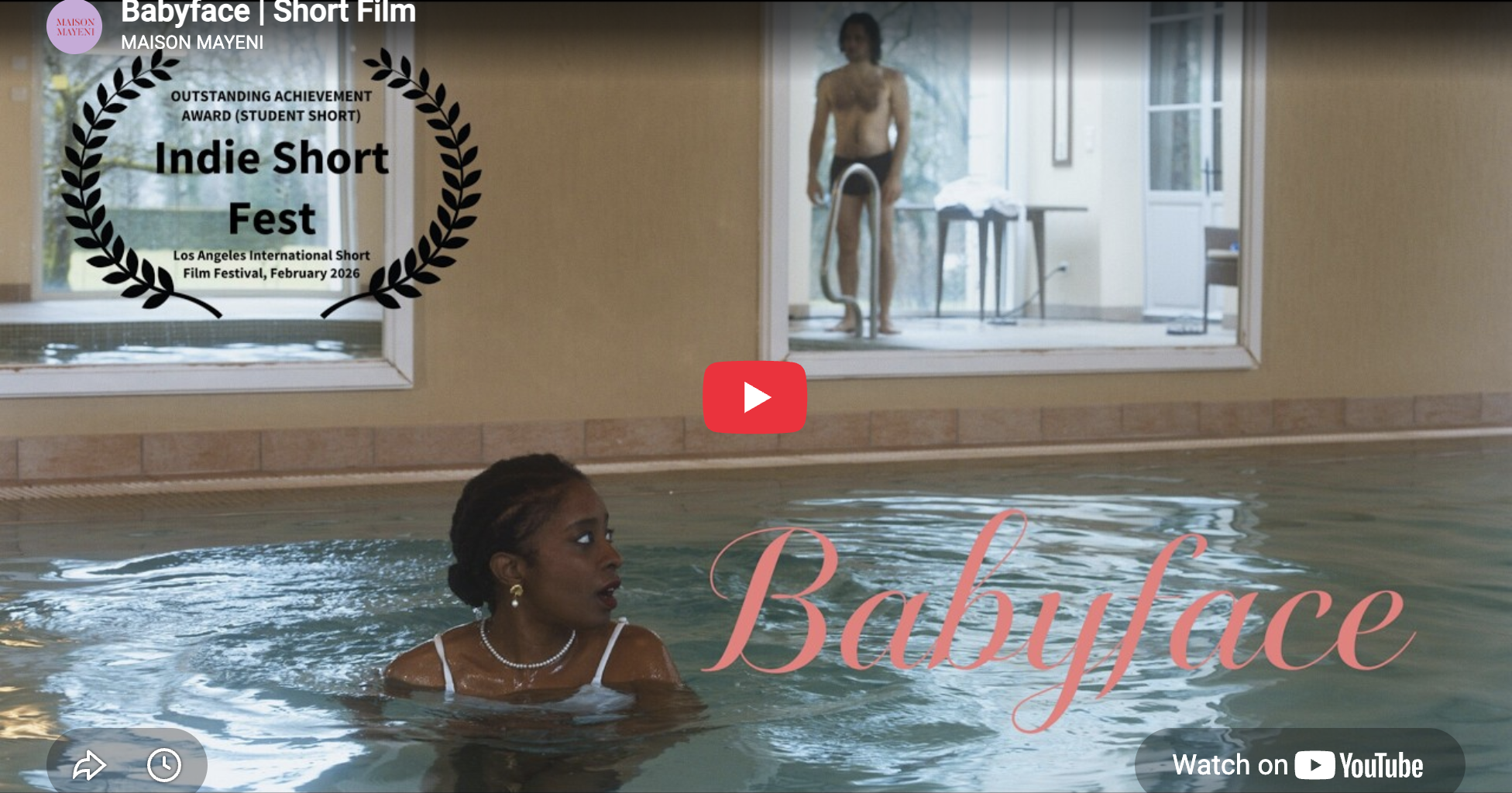
Link to Babyface: https://www.youtube.com/watch?v=Otij2n_UKdM
Director’s Interview
1. Tell us a bit about where you're from, how you got into filmmaking, and what informs your practice.
I’m Sierra Leonean and grew up in suburban Maryland. To this day, I am the only person in my family to have grown up in America, despite being the oldest of my cousins. This has definitely impacted my worldview because my family and I often differ in our views on mental health, women’s rights, and so much more. Expressing an opinion was often seen as disrespectful, as I was viewed as a child, and children were expected to be docile.
As a teenager struggling in this environment and figuring out what I wanted to be in this world, filmmaking became the space that gave me my voice back. It was a reminder to myself that my feelings matter and my opinions matter. Filmmaking has also made me love grey areas in my art and in the way I think. Because I am not blindly obedient to the ideologies of either the U.S. or Sierra Leone, I am able to think critically and choose what to take and what to leave behind.
2. What inspired you to create this story? The path we follow with Baindu is far more internal than one might expect from a film about sexual assault; why did you choose to keep us in her head?
As someone who learns and is so inspired by pop culture, I remember hearing Demi Lovato talk about maintaining contact with her rapist in order to reclaim power or control. I don’t want to speak for her, but that was my understanding. I think that was the same thing Baindu was trying to do through what she chose to tell her friends. I just find things like that so fascinating and wanted to explore that idea more, as I love to challenge perceptions.
Sexual assault is not a new topic and has already been explored extensively in media, so if I were focused on trying to make a hit film or get into a bunch of film festivals, this wouldn’t have been the first story I would pitch. I did worry about whether this story was unique enough or if I had a new perspective to add to this conversation, but I realized that it doesn’t matter whether it’s unique or not. I think every variation of this story, big or minuscule, deserves to be told. There will never be enough stories like these.
I feel like it’s important for each generation to have its own #MeToo movement. I remember that I was in middle school when the original movement happened in 2017 and could grasp the fundamentals of this topic, but not quite the complexities yet. I also wasn’t on Twitter at the time, lol, so I feel like, in my 20s, I’m now having my own personal #MeToo movement in retrospect, and I would love for others to join me in having these conversations. I feel like this is a topic that is always relevant, and we don’t need to wait until it’s trending in the news again.
I chose to keep us in her head because there is such a disconnect between what she says and what she does or we see happen. I wanted the audience to feel with her, then at times distant from her. I also want to give a shout out to our amazing actress, Rachel Summers. During casting, we were stressed trying to find someone who would really bring this subtext to life through performance and she did!
3. The most unique part of your script is undoubtedly when she tells her friend she had a threesome. We can read the discomfort in her eyes and we can sense that she is trying to lie to herself through the story she tells her friend. I think every assault victim has tried to compartmentalize in this way; but explaining that to someone who has never been coerced may struggle to understand why. A huge part of understanding survivors is understanding that first stage of denial, but we almost never see it represented in the media. How did you decide to include this in your script?
I was listening to A&W by Lana Del Rey a lot when I had the idea to tell this story. I could write a whole dissertation on this song, but I will talk specifically about the part where she sings, “If I told you that I was raped, do you really think that anybody would think I didn’t ask for it…I won’t testify, I already fucked up my story.” In a way, you could say that Baindu fucked up her story the moment she had that conversation with her friends (“But, I thought you said…?”).
Random hot take because I have no one else to talk to about this, but I didn’t love it when people immediately said that she was condoning domestic violence with her “he hit me and it felt like a kiss” lyric in Ultraviolence. I always felt like she was writing about being in denial, not condoning it, and I think that is an important perspective to discuss. It shouldn’t be hush-hush just because it's seen as controversial. When you don’t talk about these things, it makes people feel alone for having these sorts of very specific, complex feelings, and shame grows larger in silence.
I feel the same way about Lady Gaga’s Judas. It's not blasphemous, but rather discusses the concept of the spirit being willing and the flesh being weak (“Jesus is my virtue, but Judas is the demon I cling to”). In fact, it’s my favorite song to listen to on the way to church. These concepts are so raw and honest, and they are what I aspire to explore with my work.
My inner fanatic is coming out, but I am so inspired by pop music because it’s all I knew before I went to film school. I didn’t grow up next to an arthouse cinema showing a matinée of Un Chien Andalou, so all I had was pop music and pop culture, which I felt I had to hide when I went to film school and was constantly bombarded with, “What made you want to become a filmmaker?”
Yes, I had film directors who shaped me, like Ava DuVernay and Barry Jenkins, but the honest answer for me at that time would have been Britney Spears and Lady Gaga. How silly would I have sounded?
Now that I feel much more comfortable in my skin and my artistic abilities, I feel like I can finally admit that, alongside the cinematic and photographic influences I gained in film school.
4. Why did you choose a public place for the story?
It would have been cheaper and way easier to shoot anywhere else, but I knew that the film needed the specific backdrop of Amsterdam because of its notoriety for sex work, cannabis culture, and overall hedonistic behavior. This can contribute to victim-blaming: “What did you expect, going to a city known for these things?” This is something I actually heard from one of my aunts who watched the film.
I also think that sex is traditionally seen as a sacred and private act, so having it in a public space such as a hotel pool adds to this dissonance, especially when Baindu embraces one of the men tenderly after. I felt that the sounds of the water in the pool added a nice texture and soundscape that almost felt rhythmic as the story progressed.
5. What is the most important lesson from this story? What does it say about belief?
I’m not really interested in providing one takeaway for any of my work. Maybe it’s my experimental background, but I like when viewers have different interpretations and it starts a conversation, even if there is a clear direction behind each creative choice.
I can only hope that this film can help even just a few people be more compassionate towards survivors and learn to understand the psychology behind survival responses such as freeze or fawn, because it is rarely as simple as just saying no or just getting out of the pool.
6. In your head, where does Baindu go from here? What are the consequences of her experience?
I know a lot of survivors can feel like this moment defines their lives, as though there is life preceding the assault and life after. However, I have learned that life can be quite beautiful after assault. There is healing in community with other survivors, which is why I’m so grateful for this website. There is also healing in art and in owning your story without shame, despite how people (un)intentionally may try to inflict that shame on you.
I don’t love the word “consequences.” It makes the situation feel like a cautionary tale, which it is not. I have heard someone say, “Don’t be like Baindu” (with a finger wagging) after watching the film. You really can’t make this stuff up.
I think people love to focus on what the survivor could have done differently because believing they could have acted differently makes people feel more in control and less vulnerable to the harrowing reality that this could happen to anyone at any moment.
7. How do you see yourself reflected in Baindu?
Filmmaking is a performance. I am a peacock choosing when to reveal, when to hide, when to be loud, when to be quiet, when to stand out, and when to blend in. When the performance is over, I get to go backstage and remove the wigs and false eyelashes, which could be a form of expression one night and a form of hiding another. No one can ask me to account for which parts of myself made their way onto the stage.
There’s a Picasso quote I love: “If I could say this, I wouldn’t have to paint.”
8. Anything else you'd like to add?
I think it’s really fascinating answering these questions almost a year after wrapping post-production on this film. Now that all the adrenaline has worn off, I really procrastinated answering these questions in a way that I wouldn't have when I was deeply immersed in the film.
I don't feel as confident as I did when I first started conceptualizing this film. I think I was in such a beautiful bubble, created by the specific environment I was a part of in film school and the support I had around me, that burst after graduation. While I have grown in wisdom, I refuse to lose the innocence and naiveté that allowed me to make this daring film in the first place.
